India

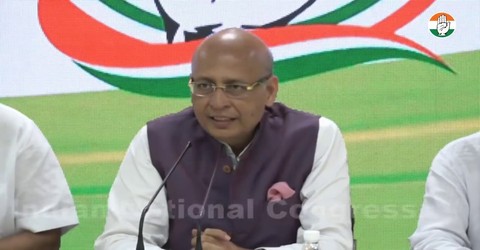
LIVE: AICC Press Briefing By Abhishek Manu Singhvi at Congress HQ on BJP's election expenses

LIVE: AICC Press Briefing By Abhishek Manu Singhvi at Congress HQ on BJP's election expenses

LIVE: AICC Press Briefing By Pawan Khera at Congress HQ on MTNL & BSNL

LIVE: AICC Press Briefing By Pawan Khera at Congress HQ on MTNL & BSNL

AICC Press Briefing By Jaiveer Shergill at Congress HQ on the Rising Bank Frauds

AICC Press Briefing By Jaiveer Shergill at Congress HQ on the Rising Bank Frauds

LIVE: AICC Press briefing by Randeep Singh Surjewala at Congress HQ in New Delhi

LIVE: AICC Press briefing by Randeep Singh Surjewala at Congress HQ

India is not the fastest growing economy

India's economy has grown at the slowest pace in the last five years. This is clear from recent figures released by the Government of India.

These reports show that the figures could be a problem for Narendra Modi, the second time Prime Minister became a troublemaker.

Economic growth in the last financial year April 2018 to March 2019 is 6.8%. At the same time, from January to March, the rate remained only 5.8%. This rate has been behind China's growth rate for the first time in the last two years.

This means that India is no longer the fastest growing economy. It will prove to be a major challenge for India's finance minister Nirmala Sitharaman. Nirmala Sitharaman has taken over the ministry of Commerce and Defense in the first tenure of the Modi government.

The current challenge to the Modi government is that they can bring back the confidence of the people towards the economy. The Modi government has to reconcile between its Short Term and Long Term Policy.

The government's first challenge will be employment.

The Modi government was surrounded by the issue of the highest employment during its first term. According to the government report, unemployment during the year 2017-18 is the highest in the 45 years.
The experts believe that the government needs to focus on labor-sector such as building construction and textile industry so that employment can be created with immediate effect. Apart from this, the government should also work on industries like health care to enable long-term jobs to be created.

Curved export also creates a major hindrance in the way of employment.

The US has ended India's special trade status since June 5, 2019. India exports 16 percent of India's total exports. In such a way, India's economy will have a bad effect. This will increase unemployment.

The United States has banned Iran from May 1, 2019. India can not import petroleum from Iran now India used to import most petroleum from Iran, which was used by India in its currency. India has been trapped in big trouble due to restrictions on Iran. India will now have to pay in dollars for petroleum. Rupee is at 69.58 level compared to the same dollar. Rupee and will fall below. This will increase inflation.

At the new GDP rate, it is clear that India's economy is rapidly falling below.

The biggest factor in China's economic growth of India is the domestic consumption here. Domestic consumption has played the most important role in increasing the economy for the past 15 years. But with recent data, it is clear that the ability of consumers to buy has decreased.

Sales of cars-SUVs have reached the lowest point of last seven years. Sales of tractors, motorcycles and scooters have also declined. The demand for borrowing from the bank has also increased rapidly. In the recent quarters, the income growth of Hindustan Unilever has also come down. Given these facts, it can be understood that the purchasing power of the consumer has come down.

The BJP promised in its manifesto that it would cut income taxes to ensure more cash and more purchasing power in the hands of the middle income families.

Gaurang Shetty, Vice President of a brokerage company believes that the government should also cut personal and corporate tax in its next budget (July).

They say that these steps will work as a stimulant for the economy.

But the difference between India's 3.4% budget deficit, i.e. government expenditure and revenue, can prevent Modi government from doing so.

Experts believe that increasing financial losses can stop short and long term growth.

The growing agricultural crisis in India was one of the biggest challenges of Narendra Modi for his first term. Farmers from all over the country, including Delhi-Mumbai, have come to the streets demanding a fair price for their crops on many roads in India.

The BJP had decided to give 6,000 rupees annually to select farmers in its first government, although the Modi government has implemented this scheme for all farmers in the first Cabinet meeting of its second term.

This plan will provide relief for some time, but this will not work in a long time. There is a need to improve the structure of the agricultural sector.

At present, farmers sell their crops to state government agencies. Whereas farmers should be able to bargain directly in the market.

One of the BJP's election promises was that it would spend 1.44 trillion dollars on railways, roads and infrastructure. But where will such a huge amount come from? Knowledgeable believe that Modi can take the path of privatization for it.

In his first tenure, Modi has worked slow on his promises to sell government enterprises. Air India has long been in debt. The government started the process of selling its shares, but no buyer was found and Air India could not be sold.

Private investment has been lagging behind for the past few years and in the last decade, India's impressive economic growth is largely on government spending.

In his first government, Narendra Modi made a few reductions in the licensing rule, with the help of which India was able to reach the 77th position in the World Bank's mercantile list, which was 134th in the year 2014.

China ready to bring 'Artificial Intelligence' into its army

China has its eyesight on the use of Artificial Intelligence in its army. This effort to advance this vast country of Asia in the case of national security interests is very important.

A white paper from the China Academy of Information and Communication at Artificial Intelligence states, "The war can be controlled in the future if it is away from the use of weapons by artificial intelligence, it will be able to control the war Can also limit the battlefield.

In 2017, the State Council of China released a report, in which the idea of ​​focusing on the production of integrated equipment of dual-use civil and military technology was given, and emphasized on modern 'artificial intelligence'.

The purpose of civil-military mail was to bring China's leading technology companies, including the private sector, under the purview of 'Artificial Intelligence' in the field of military industrial production.

In 2018, two multinational technology companies of China took responsibility for Baidu (2,368) and Tencent (1,168) and secured maximum US patents associated with research and development of 'Artificial Intelligence' within China. But China went further and invested in start ups to develop research frameworks and focused their strategy on linking them with government schemes under government schemes.

According to media reports, there is cooperation between the companies engaged in the Chinese army and artificial intelligence. It can also be understood from the fact that the Chief of the China Artificial Intelligence Association is Major General Lee Dei of the Chinese Army.

According to China's National Intelligence Law, on the issues of national security, companies should 'collaborate and assist in national intelligence'.

These efforts also start to get results. In March 2019, China overtook the United States in patenting about the new technology of Artificial Intelligence.

And to showcase his accomplishments, he has been organizing an annual Civil-Military Integration Expo for the past four years. The show features large-scale military products run by artificial intelligence, such as drones, command-control systems, training simulation equipment and unmanned war hardware.

A drone is an area where artificial intelligence can be greatly improved. Apart from other things, Artificial Intelligence will provide a drone the ability to recognize and kill unmanned aircraft on its strength in the battlefield.

Chinese companies such as Xian UAV and Chengdu Aircraft Industry Group make Chinese Fighter jets like J-10, J-11 and J-20, who are investing in drawing artificial intelligence-driven drones.

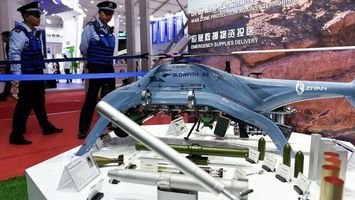
Xian UAV has developed the Blowfish A-2, which is such a drone.

The company's website says that the Blowfish A-2 completes a more complex combat mission, including mid-point or fixed-point detection, fixed-range spying and target strikes on its own.

Another Chinese company, IHang, has developed a drone called 184 AAV, which can fly 500 meters on a previously fixed route without any human assistance, it is also capable of carrying a passenger or luggage with it.

It can be used as a civil-military 'drone taxi'. This is an example of China's great effort raised in the direction of civil-military integration.

Military drone will act as a unmanned aerial aircraft (UAV) as a reconnaissance aircraft in the war zone and from there it will be able to return data to the command center.

The ability to work as a reconnaissance aircraft on a large area will turn the UAV into a machine that can monitor without human assistance.

Apart from this, those drones capable of machine learning systems will be able to make the right decisions in the war zone so that military detective will be even more precise.

Simultaneously, China's growing mastery on the 5G network technology will enable the drone to send data faster than it has never been seen before.

China has emerged as a major supplier of UAE throughout the world. Countries like UAE, Pakistan, Libya and Saudi Arabia are looking at China for this technology.

Xian UAV has sold the Bloofish A-2 UAE, its sale is being discussed with Pakistan and Saudi Arabia.

Hong Kong-based Newspaper South China Morning Post wrote that China could also set up factory for drone production in Saudi Arabia.

And media reports have said that during recent conflicts in Libya and Yemen, the drone made in China was allegedly used.

China has not signed any international agreement that controls its exports of drones and small missiles. For example, it is not in 35 countries that are part of the missile technology control scheme.

An article in the Japanese Association of Defense Industry (JADI) magazine said that China's budget for UAV development increased from $ 1.2 billion in 2018 to $ 1.4 billion in 2019.

According to the report, on this basis, Chinese investment in UAE making up to $ 2.6 billion by 2025

According to the experts, in 2016, the Chinese People's Liberation Army (PLA) handed over the research and development of the UAV to a new group of the Communist Party- Central Military Commission Subsidiary and as the Central Military Commission is headed by the President, the UAE Development Program is now in progress. Jinping comes under direct supervision.

China has also emerged as a supplier of face tracking (facial recognition) technology, its demand is increasing in many countries.

This Chinese monitoring technology has a large number of databases.

It is believed that the Ministry of Public Security is preparing one of the largest database of facial signals. It has its own focus on Xinjiang Province.

Sense Time is a startup in China that has given surveillance technology to the police in Xinjiang. However, its use is also being opposed. The company recently sold its shares to Tangli technology.

War planning software: According to official news agency Xinhua, since 2007, China is developing a software based on Central Agorithm that will be helpful in taking decisions with speed and accuracy in the battlefield.

However, it is difficult to ascertain how far China has grown, but the US and NATO have advanced technology. To challenge them, it is necessary to have very detailed information in developing new technology.

It is said that China's efforts in this area are based on activities in the United States of Afghanistan.

A report from the South China Morning Post said that the Chinese government has acquired the Lucidlitespeed software from the company of Lucia, Belgium, which provides data along with clear imagery, GPS, satellite photography, and its use in reference to the geographical location. NATO's army does.

In 2015, Xinhua registered the Chief Engineer Liu Zhong at the National Defense Technology University, who was in charge of 'Chief Laboratory of Information Engineering System'.

Xinhua said, "Professor Zhong has been imposed on developing a new technology which accelerates the pace of planning the army on the basis of artificial intelligence."

In the war zone, Zhong is one of China's leading experts in terms of software to take decisions with the help of Artificial Intelligence.

Missile: China is developing AI-powered missiles, which can attack the target without any human assistance, by detecting the target.

A report by JADI states that China has linked AI to its Dongfeng 21D, a medium-range missile. Newspaper People's Daily in the Chinese government has said that DF-21D can immobilize 'one aircraft carrier' and it is also difficult to stop it on the way.

People's Daily has also said that the DF-21D's earlier versions DF-26 can target targets of large size on the ground and even water at 4,000 kilometers, although the report may Not to mention that the missile runs from Artificial Intelligence.

Military experts say that AI-powered drones will be developed to work with ballistic missile systems so that their firepower improves.

AICC Press briefing by Pawan Khera, and Pradyot Deb Barman on poll violence in Tripura

AICC Press briefing by Pawan Khera, and Pradyot Deb Barman on poll violence in Tripura

LIVE: AICC Press briefing by Pawan Khera and Pradyot Deb Barman in Congress HQ

LIVE: AICC Press briefing by Pawan Khera and Pradyot Deb Barman in Congress HQ

Congress Working Committee Meeting: AICC Press Briefing at Congress HQ

Congress Working Committee Meeting: AICC Press Briefing at Congress HQ

Arunachal Pradesh: 11 killed including MLA in attack

In the terrorist attack in Arunachal Pradesh's Tirap district in Arunachal Pradesh, eleven people, including National Peoples Party (NPP) MLA Tirong Abo, have died.

Tirang Abo was the MLA of the party of Meghalaya's chief minister conrad Sangma. He was 56 years old.

It is being told that in the attack, the son of the legislator, Tirang Abo, also died. While two people are being told injured.

Arunachal police has confirmed this incident. According to the release issued by the police, Tirang Abo was going to Arunachal from Assam with security arrangements including his family.

In the meanwhile, some gun assaulted assailants in the Khonsa-Deomali Road ambushed their convoy.

This district of Arunachal Pradesh looks from Assam, Nagaland and Myanmar on three sides. In this area, there is considerable activity of both the National Socialist Council of Nagaland (NSCN-IM) and the NSCN- K both organizations.

It is worth mentioning that when Prime Minister Modi went to Nagaland in year 2015, he had made a cease-fire agreement with NSCN-IM. There is still a dialogue with this organization for peace process.

In Arunachal Pradesh, BJP Vice-President Dominique Tadar has told the BBC that this attack is an issue of investigation and which organization is behind it. This thing can not be said right now.

India's Union Home Minister Rajnath Singh condemned the attack and tweeted. He wrote, "The killing of MLA Tirang Abo, his family and others in Arunachal Pradesh is going to give a surprise. This is a disturbing move to disturb the peace and stability of the North East. People involved in this heinous crime will not be spared.

Chief Minister of Meghalaya and NPP chief Conrad Sangma expressed tension over the attack and tweeted that the Home Minister and the Prime Minister should take strong action against those who attacked.

Abo was contesting assembly elections this time from NPP. Earlier he was elected MLA from Congress. Union Minister of State for Home Kiren Rijiju has also condemned the attack and expressed confidence in the strong action against the attackers.

Nagaland Chief Minister Nefu Rio has also condemned the attack.

Assam Police has also condemned the attack. Assam Police has written on its Twitter handle that tribute to soldiers of other security forces, including Tirang Abo, who lost their lives in the attack in Arunachal Pradesh.