IBTN USA

Brink of Oblivion: The Fragile Calm Before the Islamabad Resumption

Brink of Oblivion: The Fragile Calm Before the Islamabad Resumption

ISLAMABAD — The world holds its breath as the clock ticks toward midnight on Wednesday, April 22, the scheduled expiration of a tense 14-day ceasefire in the 2026 Iran War. While the streets of Islamabad are lined with paramilitary patrols in anticipation of a second round of peace talks, the diplomatic atmosphere is thick with the scent of cordite and mutual distrust.

The conflict, which has pitted the combined military might of the United States and Israel against the Islamic Republic, reached a stalemate earlier this month. However, the "peace" currently observed is paper-thin. As both sides prepare to return to the negotiating table in Pakistan, the stakes have shifted from regional dominance to global economic survival.

The Collapse of Round One

The first round of talks, held at Islamabad’s Serena Hotel on April 11–12, ended in a bitter deadlock after 21 hours of marathon negotiations. Led by U.S. Vice President JD Vance and Iranian representatives, the sessions fractured over two non-negotiable pillars:

    The Hormuz Dilemma: The U.S. demanded an unconditional reopening of the Strait of Hormuz to restore global oil flow. Iran countered with a demand for the immediate lifting of all primary and secondary sanctions.

    Nuclear Redlines: Washington insisted on the full removal of enriched uranium stockpiles. Tehran, citing "Operation Midnight Hammer" (the recent U.S. strikes on its nuclear facilities), has refused to budge on what it calls its sovereign right to enrichment.

In the wake of this failure, President Donald Trump imposed a total naval blockade on Iranian ports, a move Tehran has labeled an "act of total war."

A Fragile Ceasefire Under Fire

Despite the official cessation of hostilities on April 8, the "ceasefire" has been anything but quiet. Iran has accused Israel of violating the pact via Operation Eternal Darkness, a massive series of airstrikes in Southern Lebanon. Israel maintains these strikes target Hezbollah assets not covered by the Iran-specific agreement.

    "We do not accept negotiations under the shadow of threats," stated Iranian Parliament Speaker Mohammad Bagher Ghalibaf. "If clashes resume, Iran is ready to show new cards on the battlefield."

The Road to Round Two

As of today, April 21, the resumption of talks remains perilously uncertain. While U.S. officials express "measured optimism," the Iranian delegation has yet to depart for Islamabad, citing American "bad faith."

The 14-Day Ceasefire Begins
April 8, 2026

Mediated by Pakistan, the U.S., Israel, and Iran agree to halt direct kinetic strikes to allow for diplomatic cooling.

First Islamabad Talks Fail
April 12, 2026

Negotiations collapse after 21 hours. JD Vance departs without a Memorandum of Understanding.

Naval Blockade Imposed
April 13, 2026

President Trump announces a total blockade of Iranian maritime trade, driving Brent crude above $95/barrel.

Ceasefire Expiration Deadline
April 22, 2026

The current truce ends at midnight. Trump warns that "lots of bombs" will follow if no deal is reached.

What to Expect in the Coming Days

If the second round proceeds, the mediators—led by Pakistani Prime Minister Shehbaz Sharif—are expected to propose a "Two-Phase Framework." This would involve a 45-day extended ceasefire in exchange for a partial reopening of the Strait of Hormuz and limited sanctions relief.

However, the shadow of a wider regional conflagration looms large. With the International Energy Agency (IEA) warning of the "biggest energy crisis in history," the delegates in Islamabad aren't just negotiating the fate of three nations—they are negotiating the stability of the global economy.

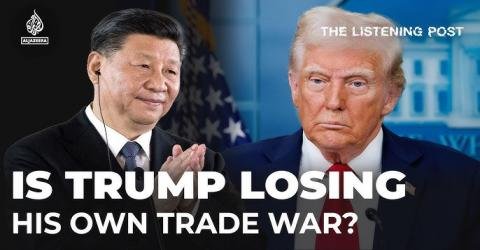
Meme warfare in Trump’s battle with Beijing

Meme warfare in Trump’s battle with Beijing

Saturday, Apr 19, 2025
A trade war that pits the world’s two largest economies against each other is now under way. Alongside the tariff battle is a heated battle of narratives and messages between the two countries.

Contributors:
Andy Mok - Senior Research Fellow, Center for China and Globalisation
Jude Russo - Managing Editor, The American Conservative
Isaac Stone Fish - CEO, Strategy Risks
Yun Sun - Director of China Program, Stimson Center

On our radar

On April 15, the civil war in Sudan hit the two-year mark. The Sudanese media landscape has been devastated. According to Reporters Without Borders, since the war began, nearly 450 journalists have fled the country. Meenakshi Ravi has more.

How Trump’s '51st state' talk galvanised Canadian voters

Donald Trump’s public musings about how Canada should become the United States’ 51st state, has Canadians rallying around their flag. The Listening Post’s Ryan Kohls discusses the Trump effect and the unprecedented impact it is having on Canadian nationalism and politics.

Featuring:
Rachel Gilmore – Host, Bubble Pop
Jonathan Kay – Editor, Quillette
David Moscrop – Author and Journalist

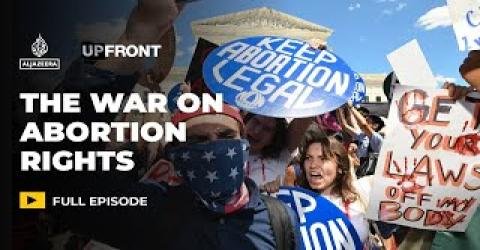
Psychological terrorism: The war against reproductive rights in the US

Psychological terrorism: The war against reproductive rights in the US

Friday, Apr 18, 2025
As Donald Trump begins his second term as president, headlines focus on immigration, trade and free speech. But advocates warn of another front, a quieter campaign targeting reproductive rights and abortion.

Just years after the fall of Roe v Wade, critics say new policies signal a renewed push to erode reproductive freedom, especially for women of colour.

Is the Trump administration waging a quiet war on reproductive rights in the United States?

This week on UpFront, Redi Tlhabi speaks with Michele Goodwin, professor of constitutional law and global health policy at Georgetown University and author of Policing The Womb: Invisible Women and the Criminalization of Motherhood.

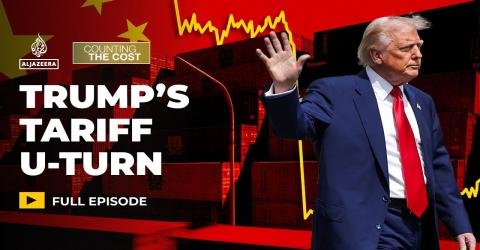
What is behind Trump's U-turn on tariffs?

What is behind Trump's U-turn on tariffs?

Thursday, Apr 10, 2025  
In a dramatic change of policy, Donald Trump has paused his so-called "reciprocal" levies on most nations for 90 days.

This, after his tariff policy sent markets globally into a freefall and left business leaders and even pro-Trump Republicans warning of a recession.

While the White House will be looking to cut deals with other nations on the levies, Trump has ramped up his trade dispute with China.

His decision to reverse course may have brought relief to markets.

But, with Trump's series of reversals since taking office in January, critics say uncertainty remains hanging over the United States economy.

Mearsheimer: The Israelis lost in Gaza

Mearsheimer: The Israelis lost in Gaza

Friday, January 31, 2025
Despite the rhetoric, US President Donald Trump will not be able to ethnically cleanse Gaza nor resolve the Ukraine war, argues University of Chicago political scientist John Mearsheimer.

Mearsheimer tells host Steve Clemons that Arab governments fear “the risk of being overthrown by their populations” should they bend to Trump’s desire to “clean out” the Palestinian people in Gaza.

On Ukraine, Mearsheimer predicts a “frozen conflict” without a peace treaty, and warns that Trump should stop “slapping around” US allies if he wants their cooperation in Europe, Latin America and Asia.

Democracy doesn’t exist in the United States: Chris Hedges

Democracy doesn’t exist in the United States: Chris Hedges

Friday, January 31, 2025
As Donald Trump returns to the White House, many are raising concerns about the possible decline of liberal democracy.

What then would a second Trump term mean for the next four years for the United States? And what impact will the president's foreign policy have on the Middle East?

This week on UpFront, Marc Lamont Hill discusses these issues with Pulitzer Prize–winning journalist and former war correspondent Chris Hedges.

US air collision: Plane collides with helicopter midair in Virginia

US air collision: Plane collides with helicopter midair in Virginia

Thursday, January 30, 2025
A plane and helicopter collision has sparked a desperate search and rescue operation in the US state of Virginia.

The Federal Aviation Administration (FAA) said late on Wednesday that a PSA Airlines Bombardier CRJ700 jet collided with a Sikorsky H-60 helicopter while on approach to the airport in Arlington County.

News agencies are citing the US Army saying three soldiers were on board the helicopter.

At least two bodies have been recovered.

All takeoffs and landings have been stopped at Ronald Reagan National Airport.

Emergency services are at the scene.

Al Jazeera’s Shihab Rattansi joins us now live from Arlington, Virginia.
 
Keith Mackey is an aircraft accident investigator and aviation consultant. He is also a retired pilot who has flown into Reagan National Airport many times. He joins us live from Ocala in Florida to discuss the latest developments. 

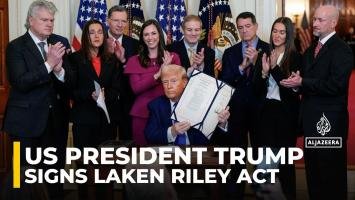
US President Trump signs Laken Riley act, in Washington

US President Trump signs Laken Riley act, in Washington

Thursday, January 30, 2025
US President Donald Trump signs the Laken Riley Act, legislation requiring the detention of immigrants living in the US illegally who are accused of theft.

Al Jazeera's White House correspondent Kimberly Halkett joins live from Washington.

How will US tech firms react to DeepSeek?

How will US tech firms react to DeepSeek?

Wednesday, January 29, 2025  
Investors have poured billions of dollars into artificial intelligence research and development over the past year, hoping to capitalise on this rapidly advancing technology.

Generative AI could automate countless tasks and change how many sectors do business.
 
The US has largely led this revolution but now a Chinese rival has emerged.

DeepSeek's models are faster, smaller and a lot cheaper.

Will investors still be willing to put up billions if a more cost-effective alternative exists?

And who is in the best position to benefit from AI's vast potential?

Presenter: Elizabeth Puranam

Guests:
R Ray" Wang -- CEO and principal analyst of Constellation Research, a technology research and advisory firm in Silicon Valley

Toby Walsh -- Professor of AI at the University of New South Wales and author of "Faking It: AI in a Human World".
 
Brian Wong - Independent geopolitical strategist and fellow at the Centre on Contemporary China and the World.

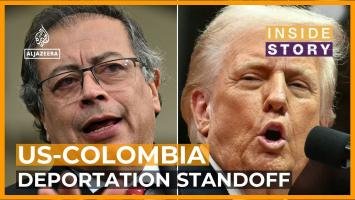
Does US-Colombia deportation row have wider implications?

Does US-Colombia deportation row have wider implications?

Monday, January 27, 2025  
An explosive diplomatic row between the US and Colombia over the deportation of unauthorised immigrants on military planes.

It has been quickly defused for now, but threats of further action are being made.

What does this signal about the new Donald Trump presidency?

Presenter:

Elizabeth Puranam

Guests:

Niall Stanage - Political analyst and White House columnist for The Hill newspaper in Washington, DC.

Sergio Guzman - Director of Colombia Risk Analysis, a political consultancy in Bogota.

Rachel Schmidtke - Senior advocate for Latin America at Refugees International in the US.