Economy

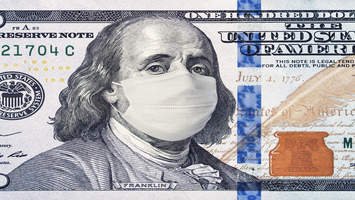
Recession in India's economy: India's GDP fell by 23.9%

The growth rate of India's gross domestic product (GDP) declined drastically in the quarter to the first months of the lockdown.

According to the Ministry of Statistics of the Central Government in India, the first quarter of the financial year 2020-21, between April to June, the growth rate has fallen by 23.9%.

It was estimated that India's GDP rate could fall to 18% in the first quarter due to the corona virus epidemic and nationwide lockdown.

At the same time, India's largest public sector bank SBI had estimated that the rate could fall to 16.5%, but the latest figures are shocking.

The Indian economy saw growth of 3.1% in the January-March quarter, the lowest in eight years.

GDP figures show that consumer spending slowed, private investment and exports declined in the March quarter. At the same time, the rate for the same quarter of June last year was 5.2%.

These new figures of GDP have historically been called the biggest declines since 1996.

These statistics have been said by the Ministry of Statistics that due to the corona virus epidemic, the data collection mechanism has been affected in addition to economic activities. The Ministry of Statistics has said that the lockdown was imposed in the country from March 25 after which economic activities were stopped.

The Statistics Ministry has said that most bodies had extended the deadline for filing legal returns. Under these circumstances, sources of data like GST were limited.

What is GDP

Gross domestic product (GDP) is the total value of all goods and services produced in the country in a given year.

Sushant Hegde, an economist at research and ratings firm care ratings, says GDP is just like a 'marksheet of a student'.

The way the marksheet shows how the student has performed throughout the year and in which subjects he has been strong or weak? In the same way, GDP shows the level of economic activity and it shows that which sectors have accelerated or declined.

This shows how well or poorly the economy has performed over the year. If GDP data shows sluggishness, it means that the country's economy is slowing down and the country did not produce enough goods as compared to last year and the services sector is also declining.

The Central Statistics Office (CSO) in India estimates GDP four times a year. That is, GDP is assessed every quarter. Every year it releases annual GDP growth figures.

Oil becomes cheaper by a weakening dollar

Due to the weakening of US dollar against the major currencies of the world, countries buying crude oil are getting oil cheaper. America's Energy Information Administration (EIA) has given this information on Friday.

Crude oil is traded in US dollars only, due to which the oil is getting cheaper for those countries whose currency has strengthened against the dollar. Countries in the eurozone are also included in this. Among them, there are many countries which import crude oil. Between June 1 and August 12, Brent crude oil prices have increased by 19 percent.

But according to EIA estimates, due to the increase in the price of the euro against the dollar, this increase in the euro has been only 12%. For the past few months, Brent crude oil prices and dollar prices have been rising in opposing directions.

While Brent crude oil is getting expensive, the dollar is weakening against global currencies. In recent weeks, global demand for crude oil has been projected to decline due to the impact of the epidemic, but the weakening dollar has only supported oil prices.

The weak US dollar means that oil buying countries are getting cheaper. According to the EIA list report this week, 4.5 million barrels of crude oil have been extracted in the week till 7 August. At the same time, seven lakh barrels of gasoline and 23 lakh barrels of distillate fuel have come down from the list.

This has led to an increase in oil prices. This oil shortage caused oil prices to rise slightly, but the International Energy Agency and OPEC have lowered their oil consumption estimates for this year and acknowledged that the global impact on the Corona epidemic will be much higher than anticipated.

Trump may ban some more Chinese companies, including Alibaba

US President Donald Trump said on Saturday that he could also increase pressure on other Chinese companies, including Alibaba.

Trump has already been banned from China-based Ticketock. At a press conference when Trump was asked if he was considering banning some other Chinese companies, including Alibaba, Trump replied, "Yes, we are looking at other things as well." '

Trump has been putting pressure on companies owned by China.

They have already banned Tiktok. The US on Friday also issued an order to ByteDance, a Chinese company, to stop TickTock's operation within 90 days.

The United States has increased this pressure on personal data security.

Trump has been a constant attacker on China for quite some time. He has transformed US-China trade relations into a central theme during his tenure.

However, there have been some occasions when he has also praised China. Trade agreements were also signed between the two countries last year praising the purchase of agricultural products such as soybeans and maize.

Former Prime Minister Manmohan Singh gave suggestions to Modi government to deal with the crisis

According to the former Prime Minister of India, Dr. Manmohan Singh, India must take three steps immediately to deal with the damage caused by the corona virus epidemic.

The credit for the economic reform program in India is largely given to Dr. Manmohan Singh. Former Prime Minister Manmohan Singh spoke to the BBC via email this week. Due to the corona virus, there was no scope of discussion sitting face to face. However, Dr. Singh refused the interview through a video call.

In an e-mail conversation, Manmohan Singh mentioned three steps needed to prevent the corona virus crisis and normalize economic conditions in the coming years.

What are the three steps suggested by Dr. Singh?

The first step, he says, is that the government should "ensure that people's livelihoods are safe and that they have enough money to spend on their hands directly through cash assistance."

Second, the government should provide sufficient capital for businesses. For this, a "government-backed credit guarantee program should be run."

Third, the government should solve the problems of the financial sector through "institutional autonomy and procedures".

India's economy was in the grip of sluggishness even before the epidemic started. India's GDP (gross domestic product i.e. GDP) has grown at a mere 4.2% in 2019-20. It has the lowest growth rate in nearly a decade.

After a long and difficult lockdown, India has now started opening up its economy slowly. However, the number of infected is constantly increasing and the future seems uncertain.

On Thursday, India became the third country to cross the 20 lakh mark in terms of Covid-19 cases.

Deep and long lasting economic slowdown

Economists have been warning ever since that India's GDP growth could decline for the financial year 2020-21, leading to the worst recession since the 1970s.

Former Prime Minister Dr. Manmohan Singh says, "I don't want to use a word like 'depression', but a deep and long-lasting economic slowdown is certain."

He says, "This economic slowdown has come due to humanitarian crisis. It needs to be seen from the perspective of the spirit of our society rather than merely economic data and methods.''

Former Prime Minister Dr Singh says that there is a consensus among economists about the economic contraction (economic contraction) in India. He says, "If this happens then it will be the first time in India after independence".

He says, "I hope that this agreement is proved wrong".

Lockdown enforced without consideration

India implemented a lockdown in late March to prevent the spread of the corona virus. Many believe that the lockdown was haphazardly implemented, and it was not anticipated that millions of migrant workers would leave big cities and move to their villages.

Dr. Singh believes that India did what other countries were doing and "there was no other option but lockdown at that time".

He says, "But, the government's sudden implementation of this big lockdown has caused unbearable suffering to the people." There was no thought behind the sudden announcement of the lockdown and its tightness and it was insensitive.''

According to Dr. Singh, "Public health emergencies such as the corona virus can best be handled through local administration and health officers." Comprehensive guidelines were issued by the Center for this. Perhaps we should have handed the war of Covid-19 to the states and local administration somewhere before.''

Dr. Manmohan Singh was in the vanguard of the economic reforms of the 90s

A Balance of Payments (BOP means the difference between the total capital coming out of the country and the capital going out of the country at a given point of time) After the crisis almost reached the verge of bankruptcy in India, as Finance Minister Dr. Singh led an ambitious economic reform program in 1991.

He says that the 1991 crisis was a domestic crisis caused by global factories. According to Dr. Singh, "But the current economic situation is extraordinary due to its comprehensiveness, scale and depth".

He says that even in the second world war, "the whole world was not closed together like it is today."

How will the government meet the shortage of money?

In April, Narendra Modi's BJP-led government announced a relief package of $ 266 billion. It included measures to increase cash and announced steps to revive the economy.

The Central Bank of India, Reserve Bank of India, ie the RBI has also taken steps like cutting interest rates and giving relaxation in repayment of loan installments.

With the government declining tax, economists are debating how the government, which is facing cash shortages, will raise money for direct transfers, provide capital to sick banks and provide loans to businessmen.

It is not wrong to borrow

Dr. Singh tells the answer to the borrowers. He says, "More borrowing is fixed." Even if we have to spend an additional 10% of GDP to meet military, health and economic challenges, we should not back down.''

They believe that this will increase India's debt to GDP ratio (ie GDP to debt ratio), but if borrowing can "save lives, the country's borders, restore people's livelihoods and increase economic growth" If there is no one should be averse to doing so.

He says, "We should not be shy in borrowing, but we should be sensible about how we are going to spend this borrowing?"

Dr. Singh says, "In the past, taking loans from multinational institutions such as the IMF and the World Bank was considered a weakness of the Indian economy, but now India can take a loan with a stronger status than other developing countries.''

"India has a great track record as a borrowing country," he says. Taking loans from these multinational institutions is not a sign of weakness.''

Will avoid printing money

Many countries have decided to print money to overcome the current economic crisis so that money can be raised for government expenditure. Some important countries have suggested the same thing to India. Some other countries have expressed concern that this will pose a risk of rising inflation.

Until the mid-1990s, the fiscal deficit (financial deficit) was directly offset by the RBI and was a common practice.

Dr. Singh says that India has now moved forward with "financial discipline, bringing institutional freedom between the government and the Reserve Bank and curbing free capital".

He says, "I know that the traditional fear of high inflation due to more money coming into the system is probably no longer in developed countries. But, with the injury to the autonomy of RBI for countries like India, the effect of printing money in an unbridled manner can also be seen in the form of currency, trade and inflation.''

Dr. Singh says that he is not rejecting printing money to make up for the deficit, rather he is "merely suggesting that the level of resistance should be very high for this and it is only meant as a final feed Should be used when all the remaining options have been used.''

India left from protectionism

They warn India to become more protectionist (imposing trade barriers like imposing higher taxes on imports) on the lines of other countries.

He says, "In the last three decades, India's trade policy has benefited every section of the country."

As Asia's third largest economy, today India is in a far better position than it was in the early 1990s.

Dr. Singh says, "India's real GDP is 10 times stronger today than it was in 1990. Since then, India has pulled out over 30 crore people from poverty so far.''

But, an important part of this growth has been India's trade with other countries. The share of global trade in India's GDP has increased almost five times during this period.

This crisis forced everyone

Dr. Singh says, "India has become more integrated with the world today. In such a situation, anything that happens in the world economy also affects India. The global economy is badly hit in this epidemic and it is a matter of concern for India as well.''

At the moment, no one knows what the full economic impact of the corona virus epidemic is? Nor does anyone know how long it will take for countries to overcome it?

"The previous crises were macroeconomic crises for which there are tried economic tools," he says. ''We are now facing an economic crisis created by an epidemic that has filled uncertainty and fear in society. To deal with this crisis, using monetary policy as a weapon is not going to prove effective.''

Maruti losses for the first time in the last 15 years

India's largest automobile company Maruti Suzuki has incurred a quarterly loss for the first time in the last fifteen years. The company's production and sales were badly affected by the Corona lockdown.

The company incurred a loss of Rs 2.49 billion in the quarter ending on June 30. Last year the company made a profit of Rs 14.36 billion during the same period.

During the first quarter of the financial year 2020-21, the company's sales have fallen by 80% compared to the previous year. In the first quarter of this year, the company was able to sell only 76,599 units of vehicles.

However, the company says that it had stopped production from March 22 due to the lockdown, so the sales figures are not good for comparison.

The corona virus destroyed the dollar that rules the economies of the world

The US dollar witnessed a sharp decline on Wednesday amid the Corona crisis. The US dollar is said to be at its lowest level in the last two years.

At the same time, pressure has been increased on the Central Banking System of the US 'Federal Reserve' to take necessary steps such as reduction in interest rates to prevent the decline.

Although the market expects the government to remain calm for the moment, some analysts speculate that the 'Federal Reserve' may take some far-reaching steps, given the way the Corona infection in the US and the tense environment is growing.

Derek Halpenny, head of research at MUFG Bank, one of Japan's largest banks, told news agency Reuters, "These things mean that we should expect more dismal conditions of economic growth." We should also focus on the US dollar to some extent.

The US dollar fell 0.4 percent against other currencies this Wednesday. This is the lowest level of US dollar since June 2018.

The US dollar has weakened 3% since the last meeting of the 'Federal Reserve'. US consumer confidence has weakened more than expected in July.

This indicates that people are reducing expenses due to increasing cases of corona infection.

"Given the concerns of the second wave of transition, the market feels that the Federal Reserve will decide to reduce interest rates," says Yujiro Goto, market expert at Nomura Security.

Former RBI Governor Urjit Patel criticized Modi government

Former Reserve Bank of India governor Urjit Patel has criticized the Modi government at the Center for the relaxation of the rules of bankrupt law during the release of his new book 'Overdraft: Saving the Indian Saver'.

Urjit Patel has said that the central government has relaxed the rules of insolvency and bankruptcy law and has also reduced the powers of the central bank, which negatively impacted the efforts made since 2014 to solve the NPA problem.

Urjit Patel, who held the post of RBI governor from September 2016 to December 2018, said that the RBI wanted the Bankruptcy Act to be strengthened so that companies in the future who are in the dilemma of default will get a lesson.

In February 2018, a circular was issued from RBI. It said that any creditor who is not paying the amount should be included in the defaulters' list. Apart from this, it was also stated in the circular that the promoters of the company that will default cannot buyback the stake in the company during the insolvency auction. The government had a different opinion on this. The government did not agree.

He told that till the arrival of the circular, he and the government had the same opinion, he used to have talks with the finance minister but after the circular came, his and the government's opinion was split. He said that the government wanted the bank to withdraw its circular but the bank refused to do so.

25 percent fall in palm crop yield due to corona epidemic in Malaysia

Malaysia's palm oil business was affected for a few months due to stress from India, but now the corona epidemic has reduced palm crop yield by 25%. This decline will further increase in the coming weeks.

This is happening due to lack of labor. The Malaysian Palm Oil Association (MPOA) said on Monday that the government's decision has had a profound impact on palm oil production, preventing the reinstatement of new foreign workers.

The government has halted the resumption of new foreign workers until the month of December due to Corona. Experts say that this decision of the government may ruin Malaysia's palm oil industry.

Najeeb Wahab, CEO of MPOA, said in a conference, "Before Kovid 19, we had about 36 thousand less workers. Our production has fallen from 10% to 25%.

Malaysia is the second largest palm oil producing country in the world. But Malaysia's industry depends on the workers of Indonesia and Bangladesh. Malaysia palm crop plantations are 84% workers from Bangladesh and Indonesia. Thousands of workers have gone back and new jobs have been closed in their place.

Due to labor shortage, palm fruit may be delayed in harvesting and this will directly affect oil production. Palm oil production is rampant in September and the entire industry is struggling with labor shortage.

Najib said that plantation companies are actively recruiting local people to follow the policy of the government, but the local people do not want to engage in this work due to the mess.

In such a situation, it is not easy to bridge the labor shortage. Najib said that if the needs of the local people are not met, then the government needs help.

Deputy Plantation Industries and Products Minister Willie Mongin has said that the ministry is working to address the problem.

He said that Malaysia is preparing to complain to the World Trade Organization because the European Union has banned the use of palm oil as biofuel.

Indonesia gives huge tax exemption to deal with corona epidemic

The economy of countries around the world has been affected by the corona virus epidemic. Indonesia has decided to increase the tax exemption for businesses to limit the impact of the epidemic on its economy.

Indonesia's tax office said on Saturday that tax relief was ending in September, which has been extended to December. In this, tax breaks will be provided to manufacturing sector and medium-small-scale industries.

In addition, corporate tax installments will also be exempt. Indonesia's government has given a $ 50 billion package to deal with the Corona epidemic. Indonesia's budget deficit for the year 2020 is expected to increase three times more than anticipated due to the relief package and declining revenue.

It can reach 6.34 percent of Indonesia's GDP. Indonesia's Finance Minister Srimulayani Indravati had earlier said that tax breaks have been provided to companies to avoid bankruptcy.

Corona virus: recession in Singapore, dangerous signal for global economy

According to the news agency AFP, Singapore has gone into recession in the second quarter of the year as the business-based Singapore economy has seen a decline of 41.2 per cent qoq.

According to the Commerce Ministry, Singapore's economy declined at a rate of 12.6% between April and June as compared to last year as stricter sanctions were imposed to prevent corona virus infection.

Thus, this is the second week of the decline in the economy when Singapore, one of the world's most open economies, has seen a decline.

This is the first time in the last ten years when Singapore has gone into recession.

Singapore's Ministry of Commerce said in its statement that "the huge decline in GDP in the second quarter is due to the restrictions imposed to reduce the spread of the corona virus between April 7 and June 1." Under these restrictions, all non-essential services and most of all places of work were closed.''

It has also been said in the government statement that the reduction in external demand due to the worldwide economic decline is also responsible for this recession.

Singapore, seen as a barometer of the health of global trade, is highly vulnerable to external shocks. In such a situation, the frightening statistics of Singapore are also giving dangerous signals for the global economy.